WELCOME TO OUR BLOG

We're sharing knowledge in the areas which fascinate us the most
click

How to Interpret PRPD Patterns for Corona, Surface, and Floating Potential Discharges

으로 DONG.WU May 27th, 2026 1 조회수

Partial discharge, or PD, is one of the most important indicators of insulation defects in high-voltage equipment. Among various PD analysis methods, the Phase-Resolved Partial Discharge pattern, commonly known as PRPD, is widely used because it provides a clear statistical view of how discharge pulses are distributed within a power frequency voltage cycle.

A PRPD pattern typically represents three key parameters:

  • Phase angle φ: the position of the discharge pulse within the AC voltage cycle, usually from 0° to 360°.
  • Discharge amplitude q: the magnitude of the discharge pulse, which may be expressed in pC, mV, dBm, or other units depending on the measurement method.
  • Pulse repetition n: the number or density of discharge pulses at a given phase and amplitude.

By analyzing the phase position, amplitude distribution, pulse density, and symmetry of the PRPD pattern, engineers can identify possible insulation defects such as corona discharge, surface discharge, and floating potential discharge.

This article introduces the typical PRPD characteristics of these three common discharge types.


1. Corona Discharge PRPD Pattern

Corona discharge usually occurs in gas insulation around electrodes with a small radius of curvature, such as sharp points, burrs, edges, or protrusions. Because corona discharge is strongly affected by polarity, the PRPD patterns of positive corona and negative corona are usually quite different.

Positive Corona Discharge

Positive corona discharge is typically associated with the positive half-cycle of the applied AC voltage.

In a PRPD pattern, positive corona pulses are often concentrated near the peak region of the positive half-cycle. Under typical AC test conditions, this may appear around 70° to 110°, although the exact phase range can vary depending on the electrode geometry, voltage level, sensor type, and test setup.
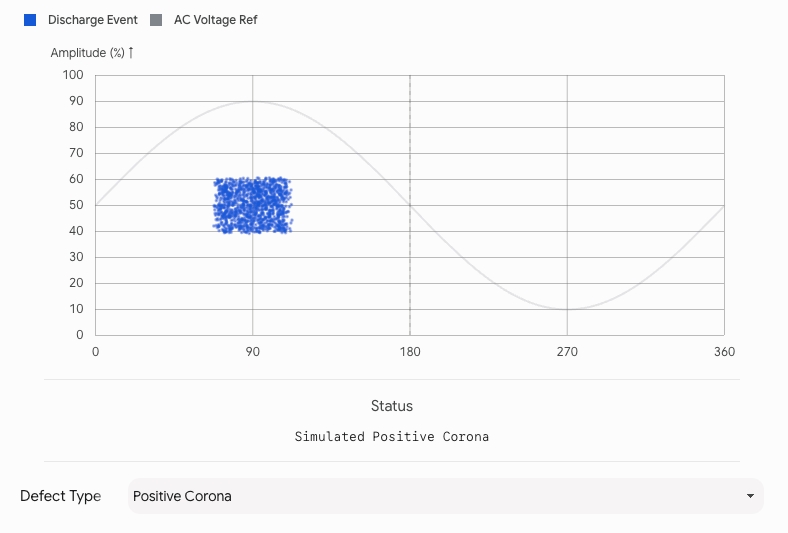
The amplitude distribution of positive corona is usually relatively stable and concentrated. On the PRPD pattern, it may appear as a dense horizontal band or a compact cluster of points. As the applied voltage increases, the phase interval may become slightly wider, while the pulse repetition rate increases. However, the amplitude may not increase significantly compared with other types of insulation defects.

Typical features of positive corona include:

  • Discharge mainly in the positive half-cycle
  • Concentrated phase distribution near the voltage peak
  • Relatively stable amplitude
  • Increasing pulse repetition rate as voltage rises
  • Compact or band-like PRPD appearance

Negative Corona Discharge

Negative corona discharge is typically associated with the negative half-cycle of the applied AC voltage. In many cases, negative corona has a lower inception voltage than positive corona and may produce high-frequency repetitive pulses.

On a PRPD pattern, negative corona pulses are commonly concentrated near the peak region of the negative half-cycle, often around 250° to 290° under typical conditions.
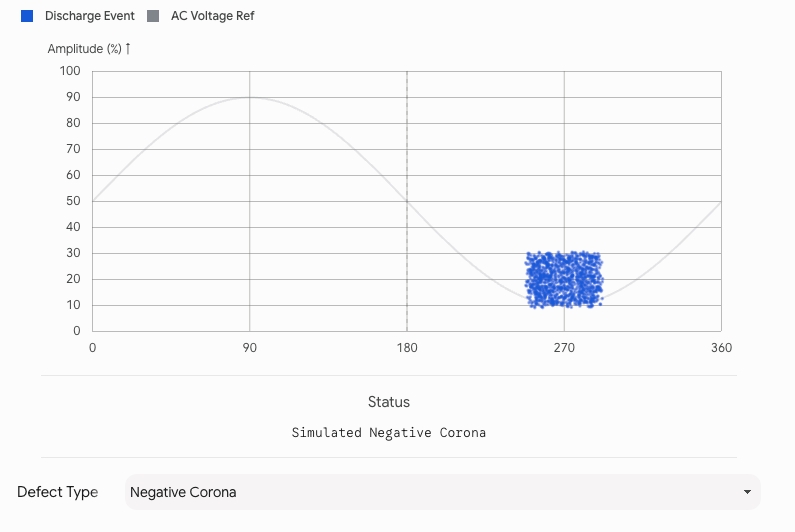
Compared with positive corona, negative corona often shows a higher pulse repetition rate, while the single pulse amplitude may be relatively small. Therefore, the PRPD pattern may appear as a very dense, low-amplitude cluster near the negative half-cycle peak.

Typical features of negative corona include:

  • Discharge mainly in the negative half-cycle
  • High pulse repetition rate
  • Relatively small single-pulse amplitude
  • Dense low-amplitude cluster on the PRPD pattern
  • Strong polarity dependence

2. Surface Discharge PRPD Pattern

Surface discharge occurs along the interface between solid insulation and gas or liquid insulation. It is often related to surface contamination, moisture, aging, poor insulation design, or uneven electric field distribution.

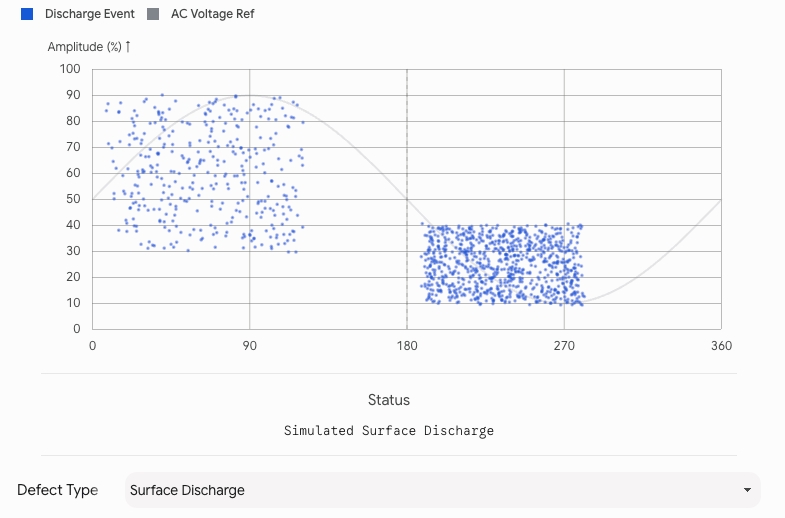
Unlike corona discharge, surface discharge usually appears in both positive and negative half-cycles. It is commonly observed on the rising edges and peak regions of the applied voltage waveform. Typical phase regions may include 10° to 90° in the positive half-cycle and 190° to 270° in the negative half-cycle.

One of the most important characteristics of surface discharge is its asymmetry.

In many cases, the discharge amplitude in the positive half-cycle is higher and more widely distributed, while the number of pulses may be relatively lower. In the negative half-cycle, the discharge amplitude may be smaller and more concentrated, but the pulse density can be higher.

As a result, surface discharge PRPD patterns often show a wedge-shaped, inclined, or “rabbit ear” appearance.

Typical features of surface discharge include:

  • Discharge activity in both positive and negative half-cycles
  • Obvious asymmetry between the two half-cycles
  • Wider amplitude dispersion in one half-cycle
  • Dense pulse distribution in the opposite half-cycle
  • Wedge-shaped or rabbit-ear-like PRPD contour
  • Strong relationship with surface contamination, humidity, or tracking

Surface discharge should be taken seriously because it may lead to insulation tracking, erosion, carbonization, and eventually insulation breakdown.


3. Floating Potential Discharge PRPD Pattern

Floating potential discharge is caused by ungrounded or poorly connected metal parts inside high-voltage equipment. Examples include loose screws, floating shielding covers, metal particles, or disconnected conductive components.

Under an alternating electric field, these floating metal parts may accumulate induced charge and periodically discharge across small gaps to nearby grounded or energized structures.

In a PRPD pattern, floating potential discharge is usually concentrated shortly after the zero-crossing points of the voltage waveform. Typical discharge phase regions may appear around 30° to 80° and 210° to 260°.
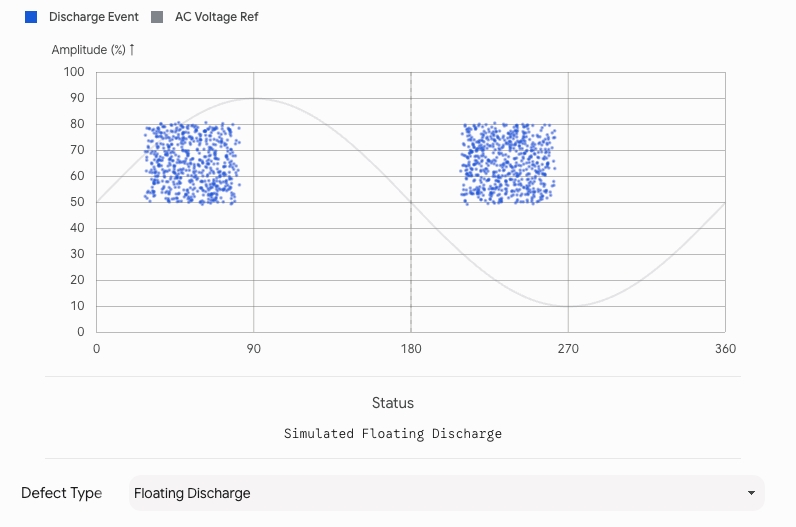
A key feature of floating potential discharge is its symmetry.

The discharge clusters in the positive and negative half-cycles are often similar in phase width, amplitude level, and pulse density. The amplitude is usually relatively stable, and the PRPD pattern often appears as two symmetrical dense clusters.

Typical features of floating potential discharge include:

  • Discharge in both positive and negative half-cycles
  • High symmetry between the two half-cycles
  • Stable discharge amplitude
  • Dense and well-defined clusters
  • Similar phase width and pulse density on both sides
  • Possible association with loose or ungrounded metal components

Because floating potential discharge is often related to mechanical defects or poor electrical connection, it may be an important warning sign in GIS, switchgear, transformers, and other high-voltage equipment.


Comparison of Typical PRPD Characteristics

Discharge Type Typical Source Phase Characteristics Amplitude and Density PRPD Appearance
Positive Corona Sharp points, burrs, small-radius electrodes Mainly near the positive voltage peak Stable amplitude, concentrated distribution Compact cluster or horizontal band
Negative Corona Sharp electrodes in gas insulation Mainly near the negative voltage peak High repetition rate, lower pulse amplitude Dense low-amplitude cluster
Surface Discharge Solid-gas or solid-liquid insulation interface Appears in both half-cycles, often asymmetric One half-cycle may have higher amplitude; the other may have higher density Wedge-shaped or rabbit-ear-like pattern
Floating Potential Discharge Ungrounded or poorly connected metal parts Appears in both half-cycles, often after zero-crossing Stable amplitude and similar pulse density in both half-cycles Two symmetrical dense clusters

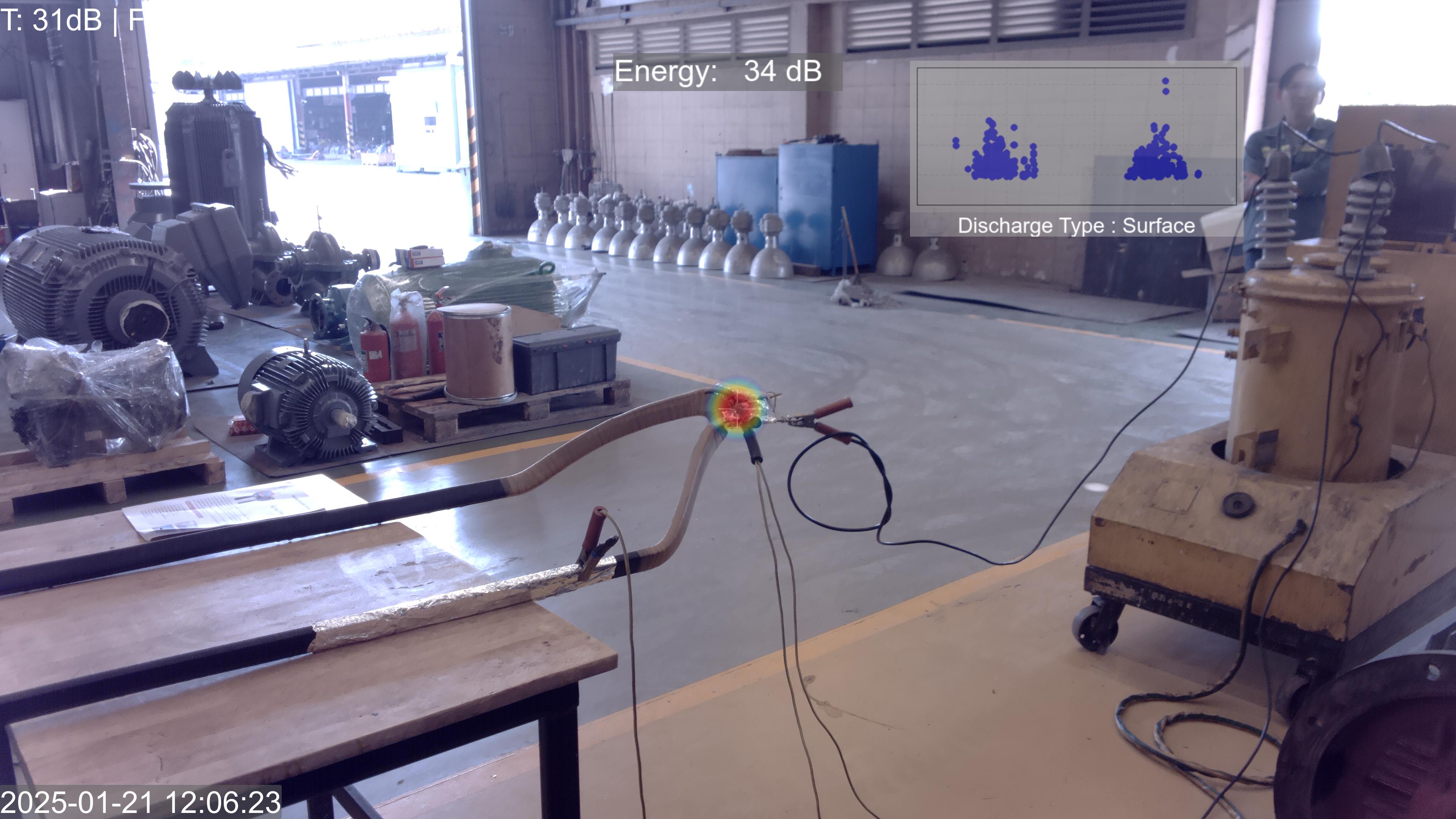
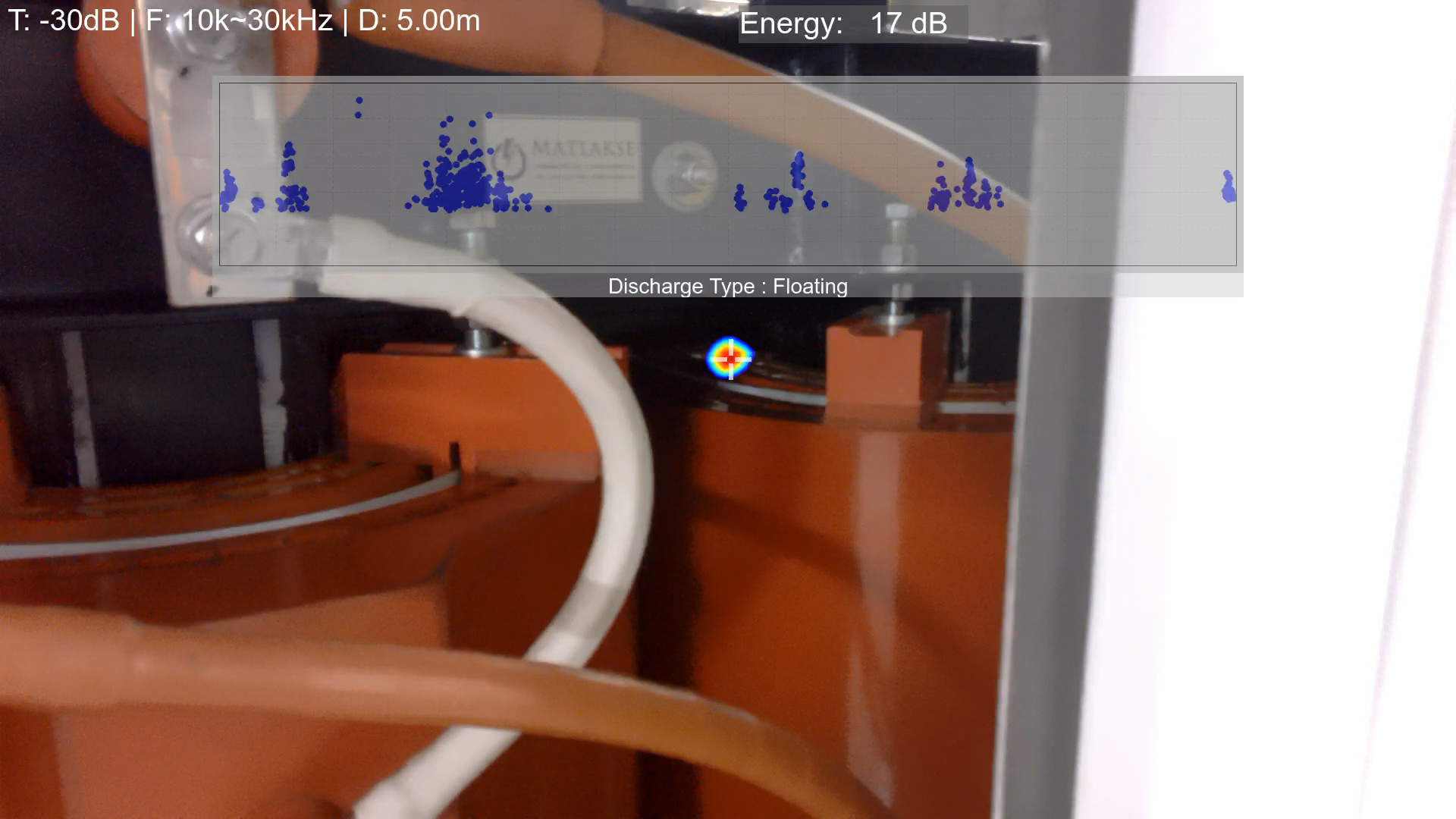
The Partial discharge pictures from Hertzinno Acoustic Camera:
Surface discharge detected by hertzinno acoustic camera
Floating Discharge 
floating discharge detected by hertzinno acoustic camera
Corona Discharge

Important Notes for PRPD Interpretation

Although PRPD analysis is a powerful diagnostic method, it should not be used as the only basis for determining insulation defects.

In real field applications, PRPD patterns can be affected by many factors, including:

  • Sensor type and installation position
  • Measurement bandwidth
  • Trigger threshold
  • Noise interference
  • Voltage level
  • Equipment structure
  • Grounding condition
  • Signal polarity
  • Phase reference accuracy
  • Multiple simultaneous discharge sources

For example, the same defect may show different amplitude characteristics when measured by IEC 60270 electrical methods, HFCT sensors, UHF sensors, TEV sensors, or ultrasonic sensors. In addition, external noise may produce phase-related or random patterns that resemble partial discharge.

Therefore, reliable PD diagnosis should combine PRPD analysis with other information, such as time-domain pulse waveform, frequency spectrum, PRPS trend, multi-sensor comparison, acoustic or UHF localization, and equipment operating conditions.


Conclusion

PRPD pattern analysis provides valuable insight into the behavior of partial discharge within a power frequency voltage cycle. Different insulation defects tend to produce different phase, amplitude, and pulse density characteristics.

Corona discharge usually shows strong polarity dependence. Positive corona is commonly concentrated near the positive voltage peak, while negative corona is often concentrated near the negative voltage peak with high pulse repetition.

Surface discharge typically appears in both half-cycles and often shows significant asymmetry, which may indicate contamination, moisture, or surface insulation degradation.

Floating potential discharge usually produces two relatively symmetrical discharge clusters in the positive and negative half-cycles, often related to ungrounded or poorly connected metal components.

By understanding these typical PRPD characteristics, engineers can better identify insulation defects, evaluate equipment condition, and take preventive maintenance actions before serious failures occur.

However, PRPD interpretation should always be combined with field experience, measurement conditions, and additional diagnostic data to achieve accurate and reliable results.

Why Hertzinno Acoustic Cameras Can Measure PRPD - From HERTZINNO,Hertzinno
이전
Why Hertzinno Acoustic Cameras Can Measure PRPD - From HERTZINNO
더 읽어보기
We use Cookie to improve your online experience. By continuing browsing this website, we assume you agree our use of Cookie.